The case against performance-based TA compensation
Day 15 of 30 Blogs in 30 Days

In a recent blog post of mine, I wrote about tying TA (Teaching assistant) compensation in NUS School of Computing to performance. I am writing this blog post to argue against performance-based TA compensation.
Context
My previous point.
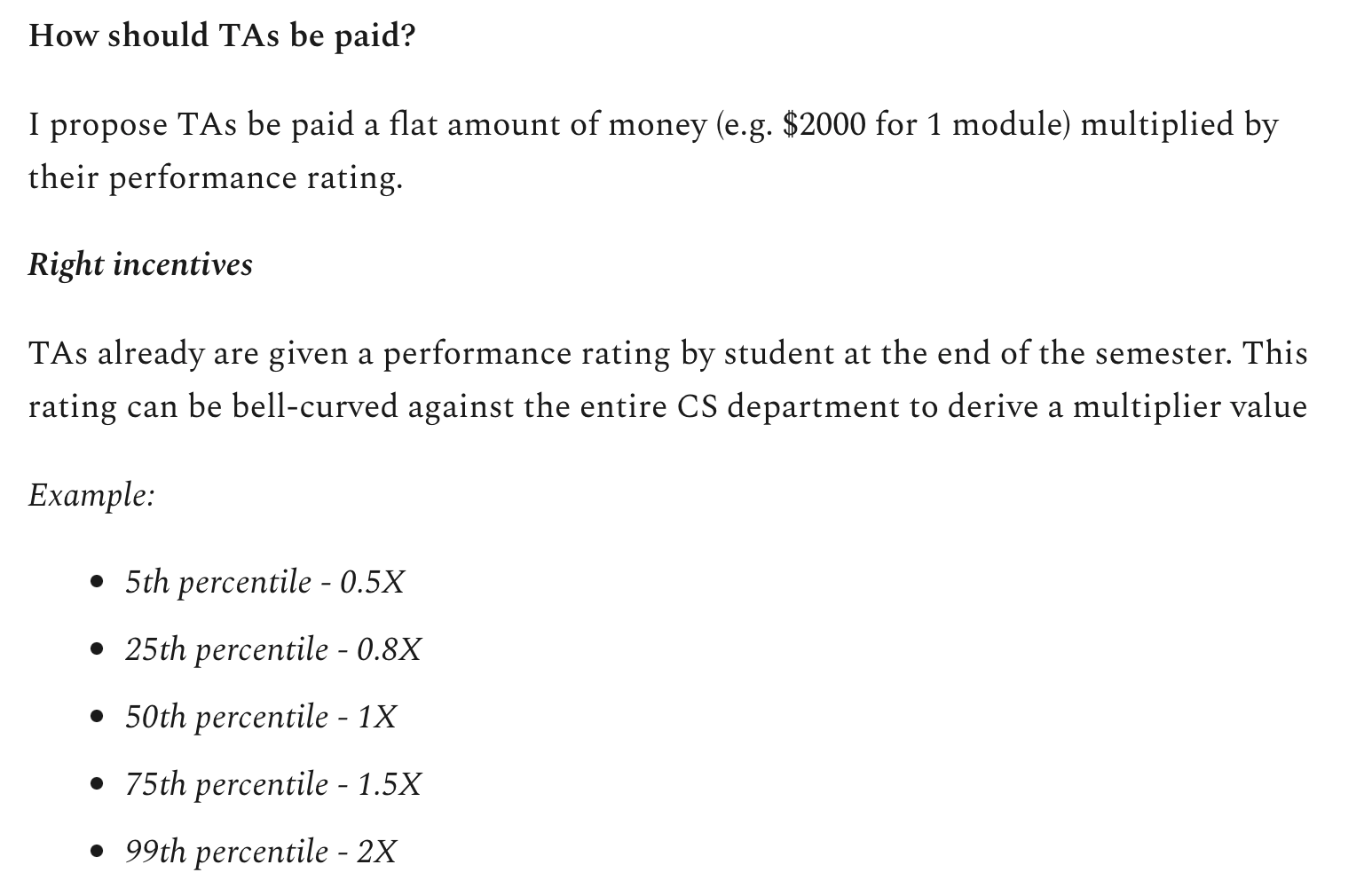
TLDR Summary
Reward for good performance
Performance bell-curved against CS department to prevent rating inflation
Do rewards motivate better performance?
Core assumption in my previous argument: Rewards motivate better performance
Does this assumption really hold true?
Performance-based pay for teachers is not a new idea. The effectiveness of which is debatable. According to a study done in New York city public schools between 2007-2009, its pay-for-performance plan for teachers did not improve student achievement. Many teachers viewed the bonuses as a reward for their usual efforts, but not as incentive to change their teaching behaviour. The authors concluded that the bonus system was not motivating enough for teachers to improve. When the rewards are too small, there is no effect on the overall system.
What about we design a compensation system that rewards the high performers significantly? (e.g. 3X pay for top 10th percentile of TAs)
When we reward the best performers, we also punish the poor performers. If the top TAs get paid 3X more, it also means the average TA would be paid 3X less than their counterparts. Chances are the best TAs right now are already intrinsically motivated by other reasons to perform. Increasing their pay by would not cause their performance to increase proportionately as they are already performing at their maximum capacity. For the average TAs however, the prospect of kicking out the incumbents on the throne would seem even more daunting. Like an average student in our “meritocratic” education system, the average TA might just do the bare minimum to maintain their position.
Stratification decreases collaboration
In the world of the bell curve, every progression made by your peer, would mean a regression for you. If we tie pay to performance, TAs would be economically disincentivized to collaborate, leading to less collaboration among TAs.
This outcome would be particularly disastrous for first-time TAs. I remember consulting my TA friend teaching the same module for advice on how to teach. Without his help, the learning curve of teaching would have been so much steeper. If helping me would result in me performing better, and less money earned for him, it would make sense for him to give me a half-hearted advice back then (Though I think he’s a nice guy and he won’t do that ☺️).
Considering the scalability of NUS School of Computing is heavily dependent on aggressive hiring of new TAs, creating policies that discourage first-time TAs would not be wise.
Divergence in teaching quality
If TA performance is bell-curved against the CS department, there would be a greater divergence in teaching quality among modules.
As students in NUS, we all know some modules have better professors, while some have less competent ones. The professor rating may have a spillover effect on the ratings of the TA. If I teach a module conducted by an eloquent and responsible professor, there’s a higher chance I would get a better TA rating and vice versa.
Assuming the above is true, I predict in the presence of performance-based compensation, TAs would flood to apply for modules taught by better professors. The natural outcome I assume is that there would be a concentration of good TAs in modules taught by good professors, and poorer TAs in the other modules. The divergence in teaching quality for different modules would be exacerbated.
Increased stress
TAs are usually undergraduate students. It is difficult enough to take 5 modules and compete against overeager A-levels straight As student in the bell-curve. If we add on the burden of performance-based compensation on TAs, would they simply just break?
I believe TA morale is vital to the overall students’ health. Unhappy teachers leads to unhappy students. Even if performance-based compensation does work in improving TA performance, it may not be worth it if we look into its effects on students’ health.
Conclusion
I do not know what would be the impact if we implement performance-based TA compensation in NUS School of Computing, but I believe the causal effect between rewards and teaching performance isn’t that straightforward.
Wait a minute, why are you disagreeing with your previous blog?
Isn’t disagreeing with yourself fun? 😉
And to be fair, I’m pretty convinced by the counterarguments at this moment. (Thank you Reddit user u/NUSHkid)
(Think, think, think again)
That’s all folks!
Talk to me if you want to.
I am reachable by
Email: rizhaow@gmail.com
Telegram: t.me/rizhaow (Preferred)
WhatsApp: wa.me/6582186566
Linkedin: linkedin.com/in/rizhaow/